
Why Carbon Life Matters
In every gold elution plant, activated carbon is both your workhorse and your hidden cost. It quietly does the heavy lifting, adsorbing gold from solution, surviving multiple elution cycles, and enduring intense heat and caustic conditions. But carbon degrades over time. And when it degrades, two things happen: your gold recovery drops and your costs go up.
Replacing activated carbon is expensive. Good quality coconut shell activated carbon costs several dollars per kilogram, and a mid-sized CIP circuit might contain 20 to 50 tonnes. If you can extend the useful life of your carbon by even a few extra cycles, the savings are significant.
More importantly, well-maintained carbon recovers more gold. Carbon in good condition adsorbs faster and more completely, and strips more efficiently during elution. The relationship between carbon health and gold recovery is direct and measurable.
The Carbon Lifecycle
Fresh activated carbon arrives with a massive internal surface area, typically 1,000 to 1,200 square metres per gram. This surface area, contained in millions of microscopic pores, is what gives carbon its gold-grabbing ability. As carbon cycles through your operation, three things gradually reduce its effectiveness:
- Chemical fouling: Inorganic and organic compounds deposit on the carbon surface and block pores.
- Physical degradation: Abrasion, attrition, and thermal stress break carbon granules into smaller pieces and generate fines.
- Pore collapse: Repeated high-temperature regeneration can collapse the internal pore structure, permanently reducing surface area.
The goal of carbon management is to slow all three of these degradation processes while keeping the carbon performing at a high level for as long as possible.
Acid Washing: The First Line of Defence
Acid washing with dilute hydrochloric acid (3% to 5% HCl) is the simplest and most effective maintenance step you can take. It dissolves inorganic deposits, primarily calcium carbonate, iron oxides, and other mineral foulants, that have built up on the carbon surface and in its pores.
When to acid wash:
- Every 3 to 5 elution cycles for most operations
- Whenever you notice declining gold recovery in the adsorption circuit
- Before elution if the carbon shows visible white or rust-coloured deposits
- More frequently if your process water is hard (high calcium)
How it works: Hot acid (80 to 90 degrees C) is circulated through the carbon bed for 30 to 60 minutes. The acid dissolves the inorganic deposits, freeing up pores and surface sites. The spent acid is drained, the carbon is rinsed with clean water, and it is ready for elution or return to the circuit.
Acid washing does not remove organic foulants. For those, you need thermal regeneration.
Thermal Regeneration: Restoring Carbon Activity
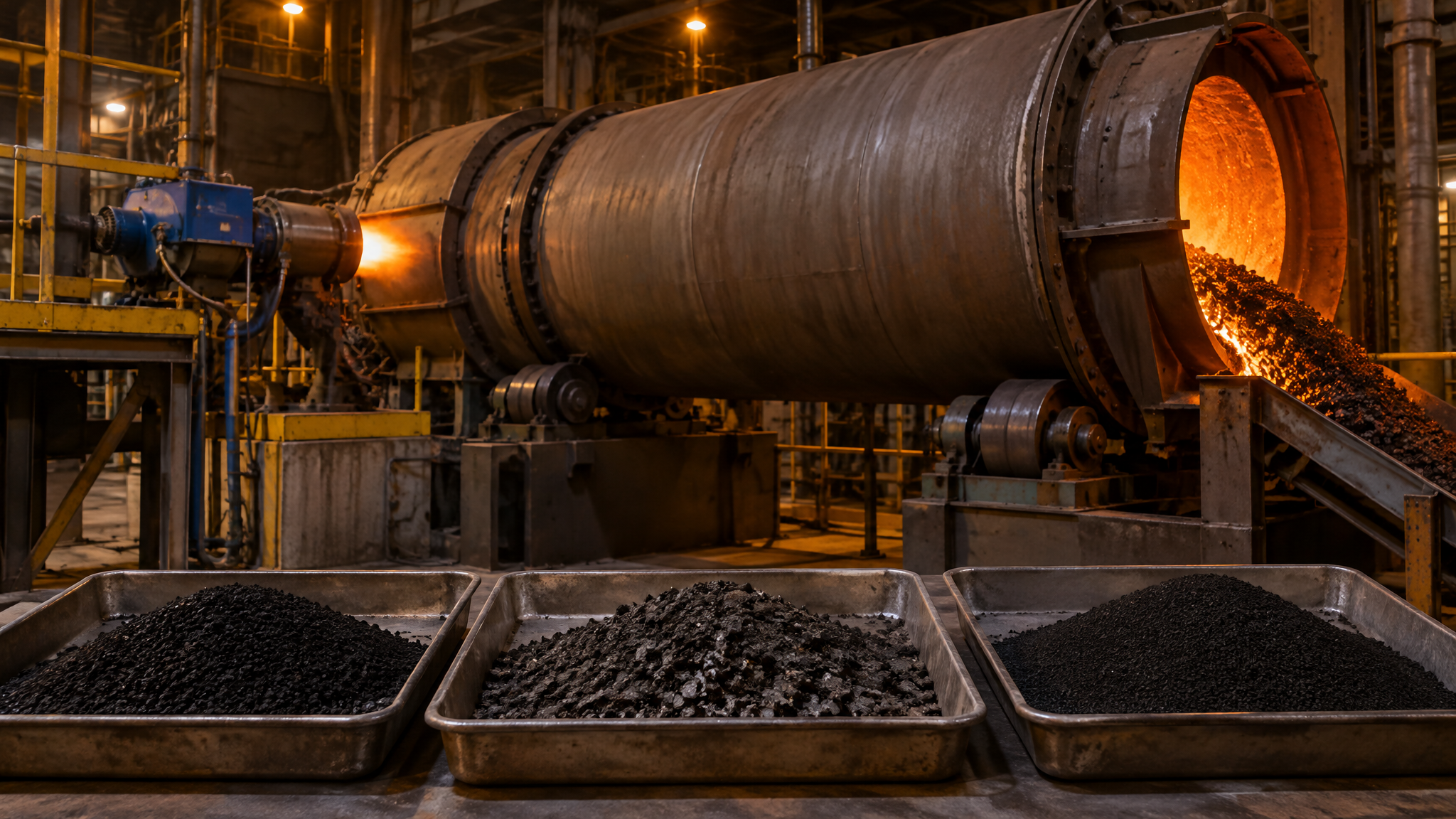
Thermal regeneration, also called kiln regeneration or reactivation, is the process of heating carbon in a rotary kiln at 650 to 750 degrees Celsius. At these temperatures, organic compounds deposited on the carbon surface burn off, and the pore structure is partially restored.
Regeneration is more aggressive than acid washing. It addresses organic fouling that acid cannot touch: flotation reagents, oils, humic acids from soil, and other organic compounds that accumulate over multiple cycles in the CIP circuit.
Regeneration frequency:
- Every 3 to 5 elution cycles is a good starting point
- When carbon activity (measured by gold adsorption rate tests) drops below 80% of fresh carbon performance
- When acid washing alone no longer restores acceptable performance
Important considerations:
- Over-regeneration damages carbon. If the kiln temperature is too high or the residence time is too long, pores collapse permanently and carbon activity drops.
- Under-regeneration leaves organic foulants behind. If the temperature is too low or the time is too short, the carbon comes out looking clean but performing poorly.
- Proper kiln operation requires temperature control, the right atmosphere (slightly reducing to prevent excessive oxidation), and consistent feed rates.
Some operations regenerate their own carbon, while others send it to dedicated regeneration facilities. At Bulawayo Elutions, we can advise on the best approach for your situation.
Screening: Removing Fines
Carbon fines, particles smaller than about 1mm, are a hidden problem. They accumulate as carbon degrades through abrasion and attrition in the CIP circuit. Fines cause problems in three ways:
- They carry gold out of the circuit with the tailings, representing a direct gold loss.
- They block flow through elution columns, causing channelling and uneven stripping.
- They increase carbon consumption because you are constantly losing material.
Regular screening removes fines from your carbon inventory. Use a vibrating screen or similar equipment to separate particles below 1mm (or whatever your specification requires) from the main carbon stock. Screen before loading carbon into the elution column and before returning regenerated carbon to the CIP circuit.
Track your fines generation rate. If fines are increasing faster than expected, investigate the cause: excessive pump agitation, poor screen maintenance in the CIP circuit, or carbon that has gone through too many regeneration cycles.
Water Quality: Protecting Carbon from the Source
Poor water quality is one of the fastest ways to ruin good carbon. Hard water deposits calcium on carbon surfaces. High-TDS water introduces competing ions. Organic-laden surface water poisons pores. All of these accelerate carbon degradation and increase the frequency of acid washing and regeneration needed.
Investing in water treatment, even a simple water softener, can dramatically extend carbon life. The cost of water treatment is usually a fraction of the cost of premature carbon replacement.
Read our detailed guide on how water quality affects gold elution for specific recommendations.
Operational Practices That Extend Carbon Life
Beyond acid washing, regeneration, screening, and water treatment, several operational practices help preserve your carbon:
- Avoid mixing old and new carbon. Carbon of different ages and conditions behaves differently in the circuit. Old, degraded carbon mixed with fresh carbon dilutes the performance of the good material. Where possible, track carbon age and batch similar-condition material together.
- Minimise mechanical abuse. Pumps, mixers, and transfer systems cause attrition. Use low-shear pumps where possible, minimise drop heights, and avoid running carbon through unnecessary transfer stages.
- Control CIP circuit chemistry. High-pH conditions (above pH 11) can cause carbon to degrade faster. Excessive cyanide concentrations contribute to fouling. Keep circuit chemistry within specification.
- Store unused carbon properly. Wet carbon stored in sealed containers retains its activity. Dry carbon exposed to air can adsorb organics from the atmosphere. If you are storing carbon between batches, keep it wet and covered.
When to Replace Carbon
Even with the best management, carbon eventually reaches the end of its useful life. Knowing when to replace rather than regenerate saves money in the long run because you stop spending on regeneration that is not producing results.
Signs it is time to replace:
- Activity after regeneration is below 70% of fresh carbon performance
- Physical degradation: excessive fines, soft granules that crush easily
- Persistent fouling that does not respond to acid washing and regeneration
- The cost of regeneration approaches the cost of new carbon
At Bulawayo Elutions, we can test your carbon and give you an honest assessment. If it is worth regenerating, we will tell you. If it is time to replace, we will tell you that too. Contact us to discuss carbon assessment.
The Economics: What Carbon Life Extension Is Worth
Here is a simple example. Say you have 10 tonnes of activated carbon in your CIP circuit, and new carbon costs $3 per kilogram. That is a $30,000 carbon inventory. If good management extends the life of your carbon by 50% (from 20 cycles to 30 cycles before replacement), you have saved $10,000 in carbon costs alone. Add the improved gold recovery from well-maintained carbon, and the total benefit is significantly higher.
The investment: regular acid washing ($100 to $500 per batch), periodic regeneration ($500 to $1,500 per batch), and water treatment ($500 to $5,000 for equipment). The return: thousands of dollars in extended carbon life and additional gold recovered.
Carbon management is not glamorous. It does not have the drama of a big gold pour. But it is one of the highest-return investments you can make in a gold recovery operation.
Frequently Asked Questions
How many elution cycles can carbon survive?
Well-managed coconut shell carbon can go through 30 to 50 or more elution and regeneration cycles. Poorly managed carbon might last 10 to 15 cycles. The main variables are carbon quality, water quality, and how well you manage fouling.
Is coconut shell carbon better than coal-based carbon?
For gold recovery, coconut shell carbon is generally preferred because of its harder structure (less attrition), higher activity per gram, and better pore size distribution for gold adsorption. It costs more per kilogram but lasts longer and recovers more gold per cycle.
Can carbon be tested to see if it needs replacing?
Yes. The standard test is a gold adsorption rate test (sometimes called a K-value or activity test). This measures how quickly the carbon adsorbs gold from a standard solution, compared to fresh carbon. If the K-value after regeneration is below 70% of fresh, consider replacement.